
Hiking in the High Atlas Mountains – Morocco
A journey through North Africa’s highest peaks, ancient Berber villages, and timeless trails
Introduction
The High Atlas Mountains stretch across the heart of Morocco like a spine of rock and snow, separating the Sahara Desert to the south from the fertile plains of the north. For hiking enthusiasts, they are an unrivalled destination: diverse terrain, centuries-old Amazigh villages, and trails ranging from short day walks to unforgettable multi-day treks.
The High Atlas extends over 700 kilometres, with more than 400 peaks exceeding 3,000 metres in altitude. Here, time moves differently — mules carry supplies up steep slopes, men in jellabas welcome travellers with mint tea, and the stars at night feel closer than you can imagine.
Jebel Toubkal — The Roof of North Africa
Altitude: 4,167 metres — Highest peak in North Africa
No article about the High Atlas is complete without Toubkal. The two-day ascent from the village of Imlil via the Toubkal Refuge is the most iconic hike in Morocco. In summer, no special equipment is required; in winter, it becomes a destination for those equipped for ice climbing. The view from the summit — where sky and earth seem to have no boundary — is worth every step.
Top Hiking Trails
1. Toubkal Summit Ascent
- Difficulty: Hard
- Altitude: 4,167 m
- Distance: 28 km round trip
- Duration: 2 days
Starting from Imlil village, this iconic route passes through the Toubkal Refuge at 3,207 m before reaching the summit. Suitable for physically fit hikers with no climbing experience needed in summer. A once-in-a-lifetime experience for any serious hiker.
2. Imlil Valley & Berber Villages
- Difficulty: Moderate
- Altitude: 1,800 m
- Distance: 15 km
A trail passing through walnut and apple orchards, ending at traditional Amazigh villages. Perfect for those who want to combine nature with culture. Local guides share mountain legends as you walk — an experience as rich as the landscape itself.
3. M’Goun Traverse
- Difficulty: Very Hard
- Altitude: 4,068 m
- Duration: 4–6 days
Morocco’s second highest peak, set deep in the Central High Atlas. The route takes you through the famous Valley of Roses and remote villages barely touched by tourism. A raw, authentic experience for the dedicated adventurer.
4. Azzaden Valley Loop
- Difficulty: Moderate
- Altitude: 2,600 m
- Distance: 20 km loop
A circular trail through the stunning Azzaden Valley, accompanied by small streams and whispering willow trees. The loop returns hikers to the starting point, making logistics simple and the experience rewarding.
5. Ourika Valley Trail
- Difficulty: Easy
- Altitude: 1,700 m
- Distance: 10 km
Ideal for families and first-time visitors. Just 60 km from Marrakech, the trail passes a beautiful waterfall and colourful local markets. The perfect introduction to the High Atlas for newcomers.
Best Seasons to Visit
Spring (March – May)
The golden season. Wildflowers bloom, snow retreats gradually, and the weather is mild and ideal for long hikes. Trails are lush and green.
Summer (June – August)
Valley temperatures rise, but the peaks remain comfortable. The best period to summit Toubkal. Start early to avoid midday heat.
Autumn (September – November)
Warm colours and breathtaking scenery. Harvest season in the mountain villages — a chance to witness Amazigh life in its fullest expression.
Winter (December – February)
For experienced hikers only. Heavy snowfall transforms the mountains into a white canvas. Suitable for ice climbing with specialist equipment. Stunning but demanding.
Amazigh Culture — The Soul of the Mountains
Hiking in the High Atlas is not merely a sport — it is a genuine immersion into a culture stretching back thousands of years. The Amazigh Berber people who inhabit these mountains uphold a rare tradition of hospitality: you will rarely finish a day without being invited to share a home-cooked couscous or a glass of mint tea by a fireplace.
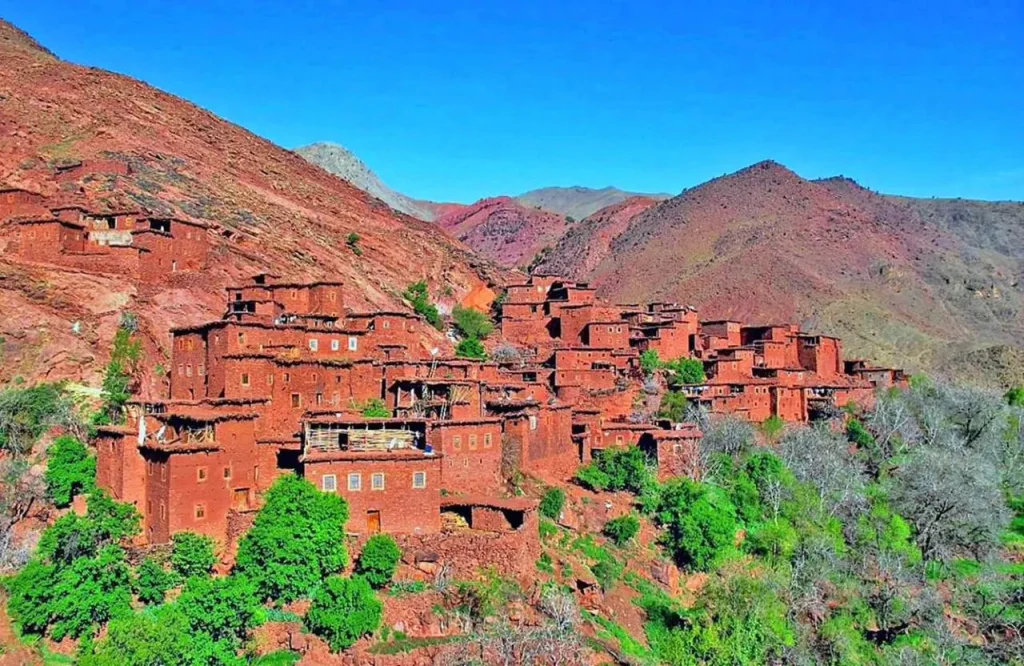
Mountain villages such as Imlil, Sidi Chamarouch, and Aroumd offer living examples of a way of life largely unchanged for centuries: homes of mud and stone that blend into the landscape, weekly markets gathering people from surrounding villages, and the music of the ribab and bendir echoing through cold evenings.
Practical Tips
- Hire a certified local guide — they know the trails and the weather
- Carry enough water: at least one litre every two hours
- Dress in layers — conditions change rapidly at altitude
- Good mountain boots are your most important piece of gear
- Do not underestimate altitude fatigue — ascend slowly
- Carry a paper map; mobile signal can be unreliable
- Learn a few Amazigh phrases — locals genuinely appreciate the effort
- Start hiking at sunrise to avoid midday heat
- Respect the mountain environment: leave no waste behind
- Bring a small solar charger to keep your phone powered
Getting There
Marrakech is the main gateway to the High Atlas. The village of Imlil — the starting point for the Toubkal ascent — is just 90 minutes away by car. In Marrakech, you will find everything you need: equipment, experienced local guides, and hiking agencies specialising in Atlas treks.
Closing Thoughts
With every step across the rocks of the Atlas, you discover yourself as much as you discover the mountain. That is the quiet secret of hiking: you do not merely ascend — you grow.
The mountain is waiting.